SAS
SAS HRS4R
HRS4R


From 1 to 3 June 2026, the International Workshop on Mathematical Statistics – IWMS 2026 was held at the SAS Congress Centre at Smolenice Castle. The workshop was organised by the Institute of Measurement Science, Slovak Academy of Sciences, in cooperation with partners from the University of Alberta, Charles University in Prague, and Comenius University Bratislava. The event continued the tradition of prestigious scientific meetings devoted to mathematical statistics and its modern applications, once again confirming that Smolenice is an exceptional venue for scholarly dialogue and the establishment of new scientific collaborations.
The conference’s philosophy was to bring together leading experts in mathematical statistics and related disciplines around the central theme “The Art of Guessing”. The workshop’s principal aim was to connect classical statistical approaches with current trends in artificial intelligence, machine learning, scientific computational modelling, and applied mathematics.
The conference programme covered both fundamental theoretical research and practical applications—from robust statistics, experimental design, inference for complex models, and characteristic functions to machine learning, explainable artificial intelligence, the fairness of synthetic data, and the optimisation of industrial processes using Bayesian methods. Modern methods for processing biological and genetic data, as well as new approaches to the analysis of high-dimensional data, were also prominent topics. The workshop thus naturally combined elegant abstract mathematical constructions with state-of-the-art computational and data-oriented methodologies.
Further details can be found in the IWMS 2026 Book of Abstracts.
The IWMS 2026 workshop was dedicated to the distinguished mathematician and statistician Professor Ivan Mizera on the occasion of his retirement from the Department of Mathematical and Statistical Sciences, University of Alberta (Edmonton, Canada).
For more than two decades, Professor Ivan Mizera built both scientific and personal bridges between countries, universities, and research communities. Through his scientific work, teaching, generosity, and distinctive sense of humour, he made a significant contribution to the development of mathematical statistics and helped bring the scientific communities of Canada, the Czech Republic, and Slovakia closer together. Symbolically, he succeeded in shortening the distance between the Canadian Rockies and the Slovak Carpathians, between Edmonton and Bratislava or Prague, as well as between Banff and Smolenice. The conference was therefore not only a scientific event but also a tribute to his extraordinary contribution to the international scientific community.
The invited speakers included several distinguished figures in international mathematical statistics and applied mathematics. The plenary lecture entitled Choquet Risk and Portfolio Choice, delivered by Professor Roger Koenker (University of Illinois Urbana-Champaign, USA), one of the founders of quantile regression, attracted considerable interest. Other highlights of the programme included presentations by Professor Christine Müller (Technical University Dortmund, Germany) on robust regression and data depth, Professor Keith Knight (University of Alberta, Canada) on adaptive methods for location estimation and data depth, and Professor Werner Müller (Johannes Kepler University Linz, Austria), who presented new possibilities for explainable artificial intelligence through experimental design.
The lecture by Professor Bei Jiang (University of Alberta, Edmonton, Canada), Achieving Fairness–Utility Trade-off with Fair Synthetic Data, also received considerable attention. It addressed the timely issue of generating synthetic data while maintaining a balance between practical utility and the requirements of fairness and the elimination of undesirable biases in artificial-intelligence models. Another important contribution was the lecture by Professor Doug Wiens (University of Alberta, Canada), Experimental Design and M-estimation: Robustness against Dependence, which focused on robust methods of experimental design and estimation under dependent observations and built upon the long-standing research tradition in robust statistics.
A particularly moving moment of the conference was the presentation by Professor Linglong Kong (University of Alberta, Canada), Ivan Mizera’s first doctoral student. In his lecture Ivan Mizera: A Scholar of Depth, a Mentor of Independence, and a Colleague of Quiet Generosity , he offered both a personal and scientific perspective on the exceptional character of his mentor, highlighting his contribution to the development of mathematical statistics, his talent as an educator, and his ability to inspire generations of students and colleagues. Together with other contributions on Bayesian optimisation methods and modern applications of artificial intelligence in biomedicine and industrial processes, these lectures formed an exceptionally diverse scientific programme.
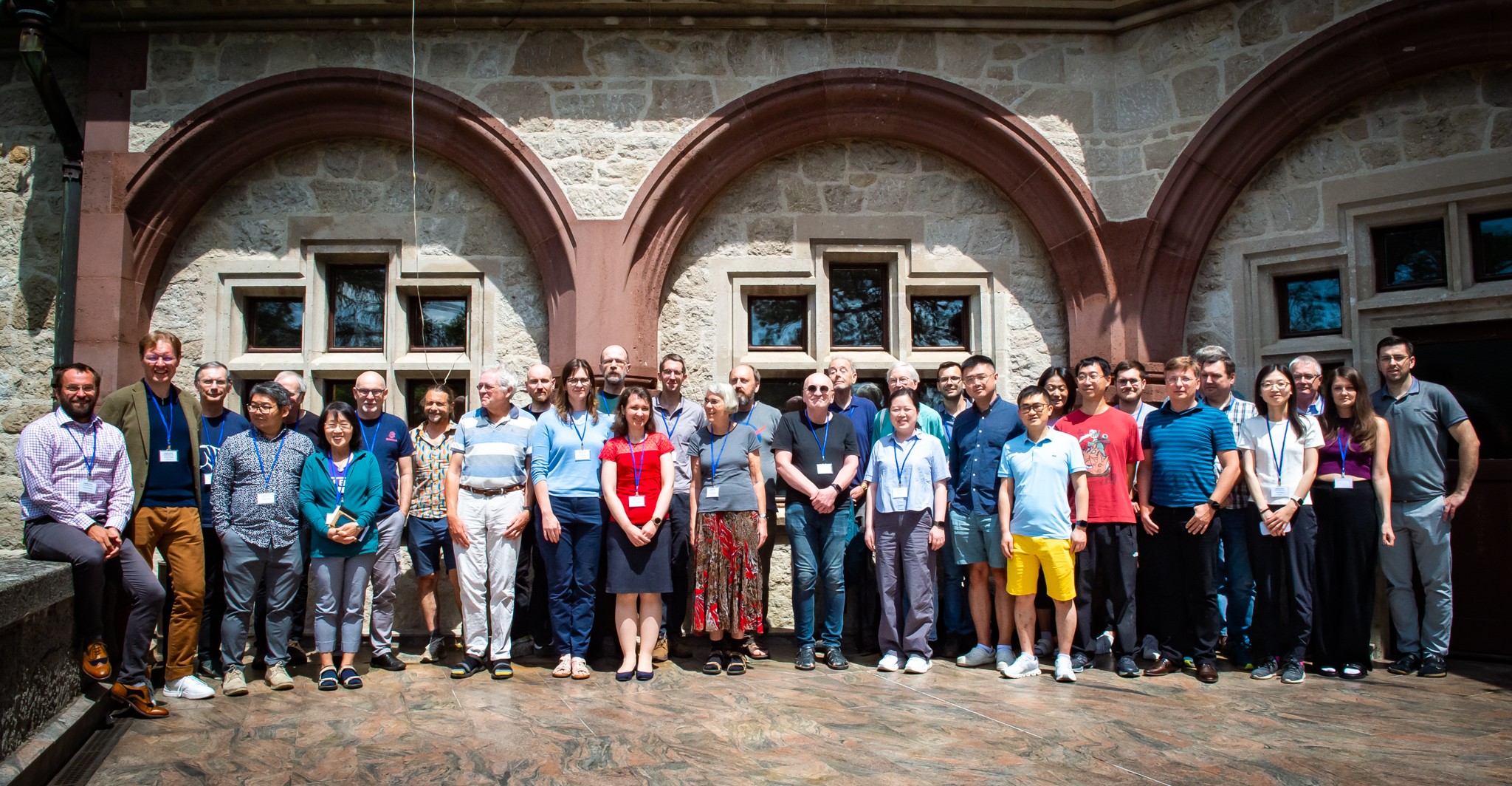
The conference featured 23 invited scientific lectures and two poster presentations, authored or co-authored by 41 researchers from 12 countries. The participating countries were Austria, Canada, China, the Czech Republic, Germany, Italy, Japan, Poland, Sweden, Switzerland, the United States of America, and Slovakia.
This broad international participation confirmed the growing importance of the IWMS workshop as a platform for exchanging the latest knowledge and building long-term scientific partnerships.
The conference participants highly appreciated not only the outstanding scientific quality of the programme but also the exceptional surroundings of Smolenice Castle and the warm, friendly atmosphere that accompanied the entire event. Informal discussions, meetings between long-standing colleagues, and the establishment of new contacts naturally complemented the scientific programme and created a unique environment for developing future research collaborations.
The IWMS 2026 international workshop once again confirmed that the Institute of Measurement Science of the Slovak Academy of Sciences is a respected organiser of major international scientific events and actively contributes to the development of mathematical statistics and its modern applications in the rapidly evolving world of data science and artificial intelligence.
Photo: Matúš Maciak